Cascode Canvas: the fastest way to truly understand distributed systems.
Distributed systems are the hardest part of computer science. Cascode Canvas makes them finally click.
You read about Raft consensus, CAP theorem, sharding, eventual consistency, or fault tolerance in books and lectures. The concepts sound reasonable on paper, but the moment you try to design or debug a real distributed system, everything feels abstract, overwhelming, and disconnected. Traditional learning methods leave huge gaps between theory and actual understanding.
Cascode Canvas changes that completely. It is a powerful, hands-on visual platform that transforms the notoriously difficult world of distributed systems into an interactive laboratory. Instead of passively reading, you can learn Raft consensus interactively as you build, break, simulate, and master architectures in real time.
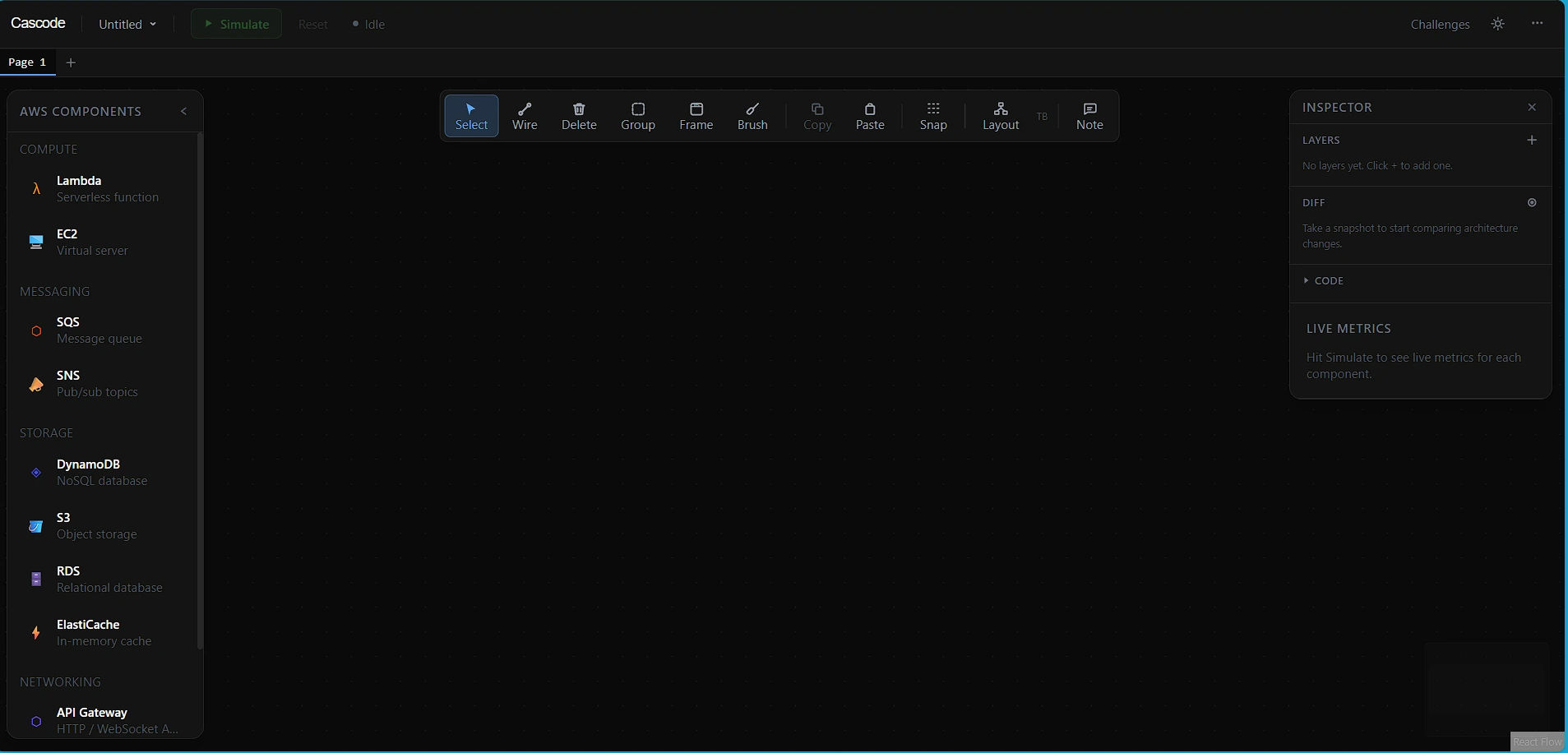 A clean, browser-based infinite canvas for designing complex distributed architectures.
1. The 5-Core Workflow: Engineering Deep Understanding Through Play
The heart of this distributed systems simulation tool is its intuitive, visual-first workflow built on React Flow. You actively construct real distributed architectures like a senior engineer.
- Build Visually: Start with a blank canvas. Drag and drop real components: AWS Lambda functions, EC2 instances, S3 buckets, SQS message queues, databases, load balancers, and API gateways. Connect them with smart edges that represent APIs, async messaging, or event streams. Zoom, pan, group, and organize even the most complex systems effortlessly.
- Simulate Chaos: Click Simulate and your entire architecture comes alive. Real-time metrics appear instantly: latency, throughput, error rates, queue depths, CPU usage, and network behavior. You can inject real-world chaos like node failures, network partitions, traffic spikes, or database slowdowns to instantly see how your design responds. For example, injecting a network partition shows a Raft cluster recovering and electing a new leader in just 200ms.
- Inspect Deeply: Click any node to open the detailed Inspector. Configure consistency models, failure probabilities, scaling rules, retry policies, and communication protocols. Use Layers to separate concerns (infrastructure, application, monitoring) so even highly complex systems stay clean and manageable.
- Compare Snapshots: Save snapshots of your design at any moment and compare them side-by-side. Visually see exactly how one small change, such as adding a cache, switching consistency levels, or introducing a new service, affects the entire system. This is incredibly powerful for learning trade-offs.
- Generate Code: Switch to the Code tab and Cascode instantly generates runnable code from your visual design. It bridges the gap between architecture and implementation, showing you exactly how your diagram translates into actual services and infrastructure.
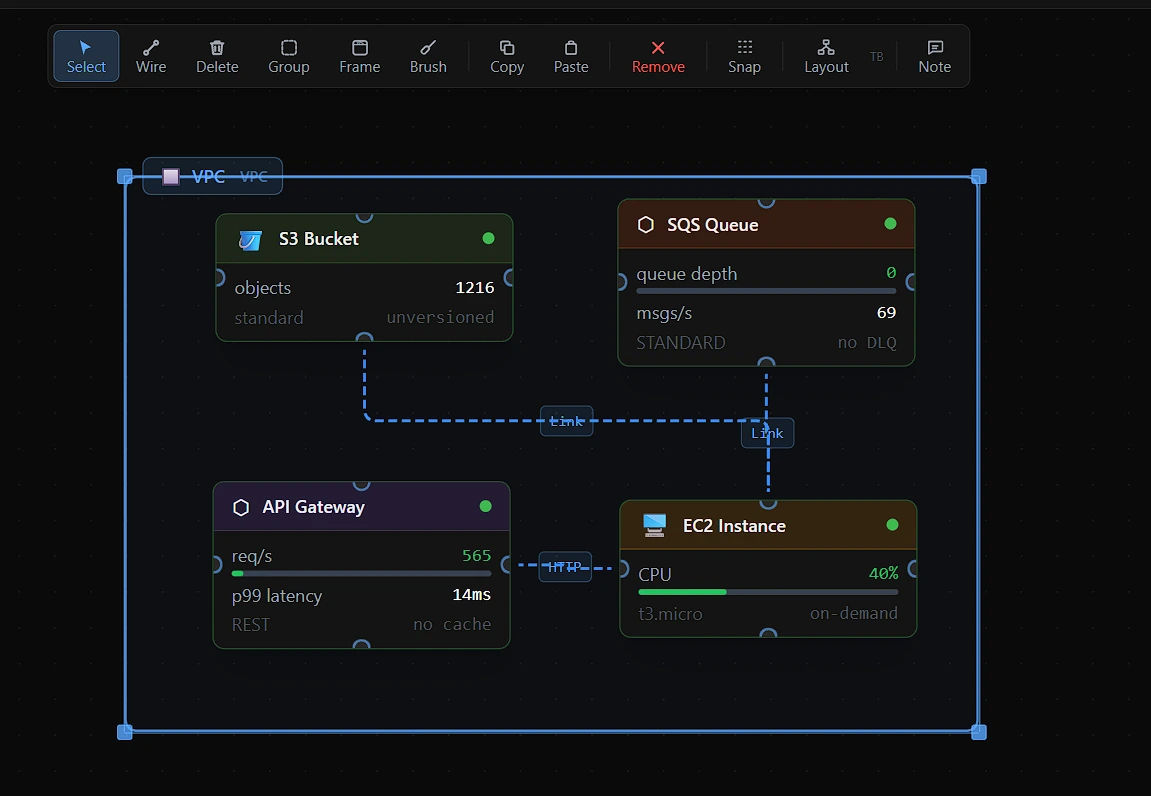 Live simulation of a microservices cluster under failure injection, showing real-time latency and throughput.
2. Real-World Applications: Who Needs Cascode Most?
Cascode Canvas is built for learners, interview prep, and engineers tackling real-world systems:
- Computer Science Students & Self-Learners: Finally understand Paxos, Raft, ZooKeeper, database sharding, or leader election by building and breaking them yourself instead of just memorizing diagrams.
- System Design Interviews: Build complex distributed systems live during mock interviews and confidently explain trade-offs in consistency vs. availability, scalability, and fault tolerance. This is the ultimate system design interview practice platform.
- Backend & Platform Engineers: Prototype new microservices architectures, test resilience patterns (circuit breakers, bulkheads, retries), and validate designs before writing production code.
- Tech Teams & Architects: Collaboratively brainstorm, iterate, and communicate sophisticated designs with a visual clarity that no static tool can match.
3. The Philosophy: Build. Break. Brainstorm.
Most resources try to teach distributed systems through passive reading. Cascode takes the opposite, and far more effective, approach.
You don’t just study failure modes; you intentionally cause them and watch the recovery. You don’t just read about eventual consistency; you simulate conflicting writes and see how the system reconciles them.
This active, hands-on method builds genuine intuition and muscle memory that lectures can never deliver. By removing friction and making experimentation instantly rewarding, Cascode turns you from a passive learner into a confident distributed systems architect.
4. Accessible, Browser-Based & Built for Learning
Cascode requires zero installation, no Kubernetes clusters, and no expensive cloud bills. Everything runs smoothly right in your browser, making interactive distributed systems education available to anyone with an internet connection.
The interface is clean, modern, fast, and thoughtfully designed. Architectures remain manageable thanks to smart layering, powerful search capabilities, undo/redo functions, and smooth performance.
5. Simple Pricing & Availability
Cascode Canvas is currently completely free to use. You can start building your first distributed system in under 60 seconds. No account is required to begin exploring the canvas, though taking a few seconds to sign up unlocks the ability to save your work and compare architectural snapshots.
Our Honest Opinion
Cascode Canvas is one of the most needed educational tools in software engineering today. In an industry flooded with theoretical content, Cascode stands out by making learning deeply embodied and experiential.
It directly destroys the biggest barriers in distributed systems education: painful setup overhead, a lack of immediate feedback, and the disconnect between pretty diagrams and real behavior. Cascode bridges the gap between diagrams and real behavior, something no other tool offers. By letting you play with live metrics, inject chaos, compare versions, and generate code from the exact same canvas, it builds authentic intuition at an accelerated pace.
Distributed systems aren’t meant to be memorized. They’re meant to be experienced.
Try Cascode Canvas free today at cascode.uk. Build, break, and master distributed systems in your browser.


