Most social networks keep human interaction trapped behind a two-dimensional screen. You snap a photo, upload a brief video clip, collect fleeting reactions over twenty-four hours, and then watch that moment sink beneath an unending algorithmic feed. We record our daily lives online continuously, yet the physical places where those events actually happen, such as neighborhood streets, park benches, historic buildings, and mountain lookouts, remain separated from our digital footprint.
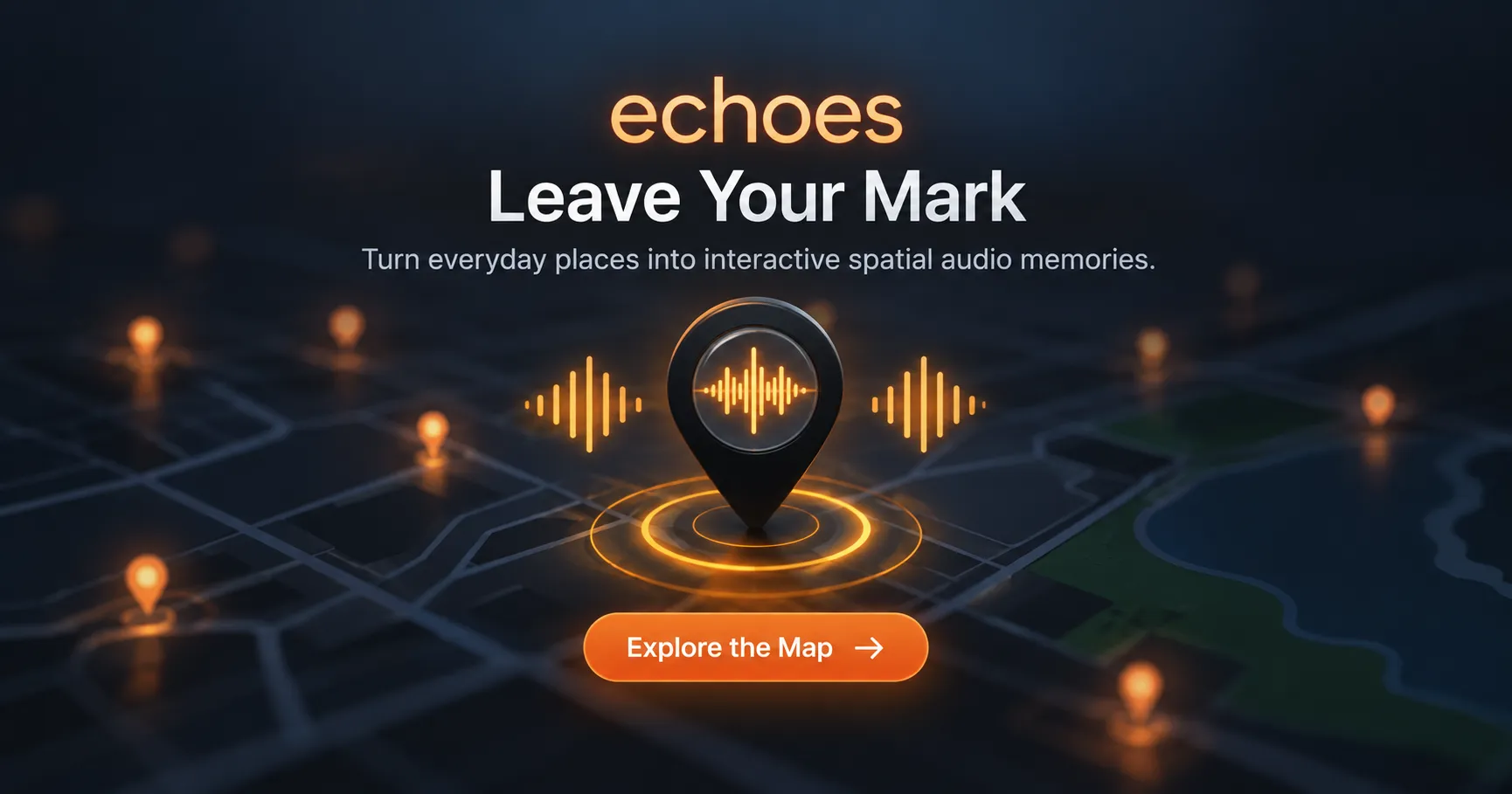
The Social Echo approaches digital sharing from an entirely different angle. Instead of pinning visual media to a flat timeline, it anchors spatial audio files directly to geographic coordinates. Developed under the mobile title echoes - leave a mark, the platform pairs three-dimensional sound calculation with location verification and decentralized data storage, building an audio layer over the physical world.
Whether you want to leave a personal voice note on a favorite walking trail or hear local history narrated as you pass an old train station, Echoes turns physical geography into a community-curated sound archive.
What Is The Social Echo?
At its core, The Social Echo is a location-based mobile application that lets people record and discover geographic audio. The platform uses specific terms to describe how users interact with this sound map:
- Echoes: Spoken audio recordings anchored to exact real-world latitude and longitude coordinates.
- Echo Orbs: Visual augmented reality (AR) markers that you can view through your phone camera to locate an audio point in physical space.
- Reverberations: Public comments and reactions attached to an existing Echo.
- Whispers: Private, direct voice messages sent between connected users.
- Echo Travelers: Community members who navigate the real-world radar map to find and listen to recordings.
An Echo is not a conventional podcast episode or a standard chat voice note. It is geographically fixed. To experience an Echo the way its author recorded it, you walk to that specific physical location, put in headphones, and listen as you explore the surroundings.
The Technology Behind the Echo Engine
Playing audio based on GPS coordinates is not new, but standard applications simply trigger a flat stereo audio file when you cross a digital boundary. The Social Echo replaces flat playback with an interactive acoustic environment built on three core technical systems: spatial audio modeling, location verification, and permanent storage.
1. Spatial Audio via HRTF Algorithms
In ordinary life, your ears determine where sounds originate by analyzing tiny differences in arrival time and frequency. A sound coming from your left reaches your left ear a fraction of a millisecond before your right ear, with sound wave frequencies slightly altered by the shape of your head, ears, and shoulders.
The mobile application models this natural acoustic behavior using Head-Related Transfer Functions (HRTF):
- Directional Orientation: If an Echo is pinned to a stone monument, facing that monument puts the sound dead center. If you turn ninety degrees to your left, the speaker's voice naturally pans to your right ear.
- Proximity Scaling: Sound volume dissipates over distance according to real-world physics. As you walk toward an Echo, the audio gains volume and clarity. As you walk away, it blends into ambient city sounds until it fades completely.
This acoustic design makes listeners feel as though the speaker is standing right beside them on the pavement.
2. Proof of Presence (PoP) Protocol
A major challenge for location-based platforms is GPS spoofing. If users can fake coordinates using software emulators, public maps quickly fill up with remote spam, promotional bots, and misleading tags.
To protect network integrity, The Social Echo uses a proprietary Proof of Presence (PoP) verification system. This protocol checks multiple device and location signals to verify that a person is physically located at the specified coordinates before letting them publish an Echo. By requiring real-world presence, the platform ensures that every audio pin represents a genuine human visit.
3. Permanent Decentralized Storage on Arweave
Standard social applications store user media on centralized corporate servers. If the operating company alters its service model, runs out of funding, or deletes older files to cut hosting expenses, user memories disappear.
The Social Echo writes audio records to Arweave, a decentralized storage network called the "permaweb." Arweave runs on an upfront endowment model: data storage fees are paid once at the time of writing, providing sustainable funding for independent storage miners to retain those files permanently.
Storing audio on Arweave provides clear advantages:
- Audio recordings remain immutable and cannot be altered or removed by third parties.
- Memories remain accessible across generations.
- The community retains access to anchored files even if central application servers experience downtime.
Technical Specifications and Architecture
| Component | Technical Implementation | Practical Benefit |
|---|---|---|
| Acoustic Modeling | Head-Related Transfer Functions (HRTF) | Audio shifts direction and volume naturally as you turn your head or walk. |
| Location Integrity | Proof of Presence (PoP) Protocol | Prevents GPS spoofing so only genuine visitors can anchor audio. |
| Data Preservation | Arweave Permaweb | Saves recordings permanently without risk of server shutdowns or data loss. |
| Account & Permissions | Supabase Database with Row-Level Security | Manages user profiles, authentication, and per-echo privacy rules safely. |
| Visual Augmented Reality | Device Camera & ARKit Integration | Projects visual Echo Orbs into your physical surroundings. |
| Spam Prevention | $ECHO Utility Token | Micro-costs for minting discourage automated posting and low-effort clutter. |
| Community Zoning | Echo DAO Governance | Lets token holders vote to protect quiet places like parks and memorials. |
The $ECHO Protocol: Network Rules and Governance
A decentralized spatial network requires transparent economic and governance rules to prevent clutter and manage public space responsibly. The platform runs on its native utility token, $ECHO.
Minting and Spam Prevention
Free public message boards frequently fall victim to automated advertising. The Social Echo addresses this by requiring creators to spend a small amount of $ECHO to "Mint" and anchor a permanent memory onto the map.
Because minting requires a minor cost, users think carefully about what they publish. This fee acts as an automatic quality filter, favoring genuine stories, local facts, and thoughtful notes over bulk commercial noise.
Staking for Spatial Zoning (Echo DAO)
Not every physical space is suitable for high-density audio or promotional clips. Quiet nature trails, cemeteries, historic monuments, and religious sanctuaries require quiet respect.
Holders of the $ECHO token can stake their tokens to take part in the Echo DAO (Decentralized Autonomous Organization). DAO members vote on spatial policies:
- Protected Zones: Establishing sensitive historical or natural locations as permanently ad-free zones.
- Density Limits: Setting minimum distances between audio anchors to prevent voices from overlapping into unintelligible noise.
- Content Standards: Managing community reporting standards to keep public spaces safe and accessible.
Discovery Rewards for Active Explorers
The network depends on real-world exploration to discover hidden gems and verify historical points. The ecosystem treasury distributes $ECHO rewards to users who:
- Walk to and discover rare Genesis Echoes placed at notable global landmarks.
- Create accurate, highly rated local guides that provide genuine educational value.
- Help curate local neighborhoods by flagging improperly placed or broken audio pins.
Ecosystem Utility for Token Holders
Holding $ECHO provides practical perks across the platform:
- Creator Badges & Ranks: Stand out on the mobile map with distinct visual badges.
- Web Management Dashboard: Access an online workspace to arrange and manage multi-point spatial sound environments.
- VIP Community Access: Participate directly in governance votes, access private community channels, and get priority access to real-world events.
.webp?tr=w-360)
Practical Everyday Uses for Echoes
Anchoring 3D audio to precise physical coordinates enables practical applications across education, tourism, personal expression, and neighborhood commerce.
1. Independent Walking Tours and Living History
Standard guided tours often require large tour groups or printed pamphlets that pull your attention away from your surroundings. With Echoes, local historical societies, preservation groups, and longtime residents can attach spoken stories directly to historic structures and bridges.
When you walk past an old railway depot, you can hear a local historian describe how the depot shaped the community a century ago. Because the audio is directional, the guide can tell you to look up at an architectural detail on your left, creating a natural and personal learning experience.
2. Personal Keepsakes and Time Capsules
People build strong emotional connections to specific locations: a bench where they studied for college finals, a park where they met a close friend, or a lookout where they made a major life decision.
Users can leave an Echo at these spots as a digital time capsule. Friends and relatives who visit that exact place years later can put in their headphones and hear your voice describe that day, keeping memories tied to the places where they happened.
3. Spatial Scavenger Hunts and Outdoor Discovery
Because the platform tracks physical movement, creators can design interactive sound trails. A creator can hide audio clues across a botanical garden or historic district, where listening to one clue gives you the directional hint needed to locate the next. This provides an active, screen-free way to explore unfamiliar neighborhoods.
4. Hyperlocal Commerce via Audio Vouchers
Independent neighborhood businesses often find online display ads expensive and poorly targeted for nearby pedestrian traffic. The Social Echo offers local shopkeepers a direct tool called Audio Vouchers:
- A coffee shop or bookstore drops an audio note near a pedestrian crossing.
- When walkers pass by, they hear a brief greeting or a special daily offer.
- Explorers collect the voucher directly inside the app and stop by the counter to redeem it.
This keeps commercial messaging contextual and relevant, helping independent businesses connect with people already walking by their doors.
Mobile Application Features and Interface
The iOS application, developed by George Alexandru Nicoara under The Social Echo, provides a focused feature set designed for simple navigation:
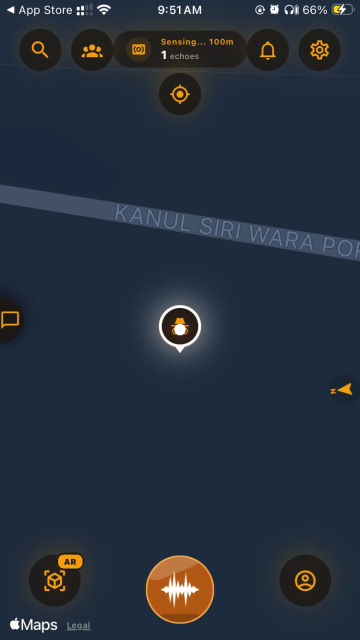
- Tactical Radar Map: Displays nearby sound nodes as glowing points around your current position, indicating distance and direction.
- Built-in AR Mode: Uses your device camera to project visual Echo Orbs into your physical view, helping you pinpoint exact positions.
- Private Whispers & Voice Notes: Send private voice messages up to two minutes long, complete with interactive sound waveforms.
- Message Controls: Includes message retraction ("Unsend") to remove a message and its audio from both sides instantly, alongside emoji reactions and report options.
- Per-Echo Privacy Settings: Creators can set any recording to Public, Friends, or Private. Privacy settings can be updated after publishing and are enforced server-side using database row-level security.
- Map Display Controls: Personalize your view with toggles for 3D buildings, points of interest, street names, marker animations, and ghost mode for privacy.
- Flexible Access: Browsing the map does not require an account. Signing in via Apple or Google is only required when recording an Echo, leaving a comment, or sending a Whisper.
Official Project Roadmap
The Social Echo follows a four-phase development timeline designed to build foundational content before opening up developer tools:
Phase 1: The Genesis (Q1 2026)
- Publication of the technical whitepaper.
- Initial $ECHO token private sale.
- Seeding the global map by dropping Genesis Echoes across 500 historic landmarks worldwide.
Phase 2: The Echo Beta (Q2 2026)
- Launch of the iOS application, followed by the Android Alpha release.
- Rollout of the interactive Spatial Scavenger Hunt feature.
- Expansion of early community testing across varied urban environments.
Phase 3: The Spatial Economy (Q3 2026)
- Launch of the dedicated Business Portal.
- Merchant tools allowing local businesses to fund and drop Audio Vouchers paid in $ECHO.
- Introduction of neighborhood economic incentives for active walkers.
Phase 4: Global Resonance (Q4 2026)
- Full public consumer launch across all major mobile platforms.
- Release of the Developer SDK, enabling independent studios, museums, and educators to build custom audio tours and spatial soundwalk games on top of the Echo network.
Addressing Practical Platform Considerations
Any application that combines location tracking, spatial audio, and public contributions must handle practical real-world concerns:
Battery and Data Management
Continuous GPS tracking and real-time 3D audio rendering can drain mobile batteries quickly. The app manages consumption by caching audio files over local Wi-Fi when possible and reserving high-precision location checks for when you get close to an active sound node.
Preventing Audio Overlap
If too many recordings are placed on a single street corner, listening could become confusing. The platform applies minimum distance buffers between pins, allows users to filter categories on their map, and gives DAO members tools to manage pin density in busy city centers.
Safety and Content Moderation
Decentralized networks must protect open participation while preventing abuse. While Arweave provides permanent, tamper-resistant storage at the protocol layer, the application maintains client-side moderation tools. Users can flag objectionable content or block individuals, and community moderators can hide harmful recordings from the public app feed while leaving the underlying decentralized protocol neutral.
The Broader Value of Ambient Spatial Computing
Modern mobile technology frequently pulls our attention downward, asking us to stare at glass screens while ignoring the world around us. Spatial audio offers a healthier alternative: it adds context and human voices to our physical environment while keeping our eyes up and our hands free.
The Social Echo demonstrates how location-based technology should work in daily life. By combining HRTF 3D sound, Proof of Presence verification, permanent Arweave storage, and community governance, it turns everyday streets and landmarks into a living, shared sound archive.
Final Verdict
The Social Echo offers a refreshing break from visual social media and algorithmic feeds. By turning physical geography into an interactive audio canvas, it reconnects users with their immediate surroundings instead of gluing their eyes to a glass screen.
The platform stands out for its strong technical foundation. Rather than relying on simple proximity playback, the team built a true 3D acoustic model through HRTF algorithms, paired it with Arweave permanent storage to eliminate link rot, and introduced a Proof of Presence protocol to stop fake GPS pins.
While widespread success will depend on how quickly community creators populate the map and how well battery life holds up during long walking tours, the core concept is practical, human, and genuinely innovative. For urban explorers, history enthusiasts, and anyone curious about the future of screen-free augmented reality, Echoes is well worth downloading on your next walk.


